
As industrial intelligence becomes increasingly widespread, robots are now extensively used across many industries. Common industrial robotic arms, site patrol robots, and general-purpose intelligent inspection devices are typically designed for clean, non-hazardous environments at normal temperature and pressure. In the petrochemical industry, however, production sites contain flammable and explosive gases, toxic and hazardous media, as well as densely installed high-temperature and high-pressure equipment, making conventional robots unsuitable for use.
Petrochemical explosion-proof special-purpose inspection robots are often confused with conventional industrial robots, but in fact they differ fundamentally in safety standards, hardware design, functional adaptability, and operating logic. They are intelligent systems engineered for two entirely different categories of industrial environments.
The most fundamental and defining difference between the two lies in explosion-proof safety design and adaptability to operating conditions, which is also the key reason petrochemical special-purpose robots are irreplaceable. Conventional industrial robots are mainly used in safe environments such as factory production lines, indoor warehouses, and ordinary industrial parks. Their design focuses on operational efficiency and precision, without the need to address special requirements such as explosion protection, corrosion resistance, or static-electricity control. Tiny electrical sparks, static discharge, and hot surfaces generated during equipment or circuit operation have little consequence in normal environments, but in explosive gas atmospheres such as petrochemical tank farms and refining units, they can readily ignite oil-gas mixtures and trigger explosions or fires. Petrochemical explosion-proof special-purpose robots therefore adopt dedicated explosion-proof design for the complete machine and are certified to high national explosion-protection standards. Their electrical circuits, flameproof enclosures, static-electricity control, heat dissipation, and temperature management are specially engineered to eliminate ignition sources at their origin, allowing safe and stable operation in high-risk explosive env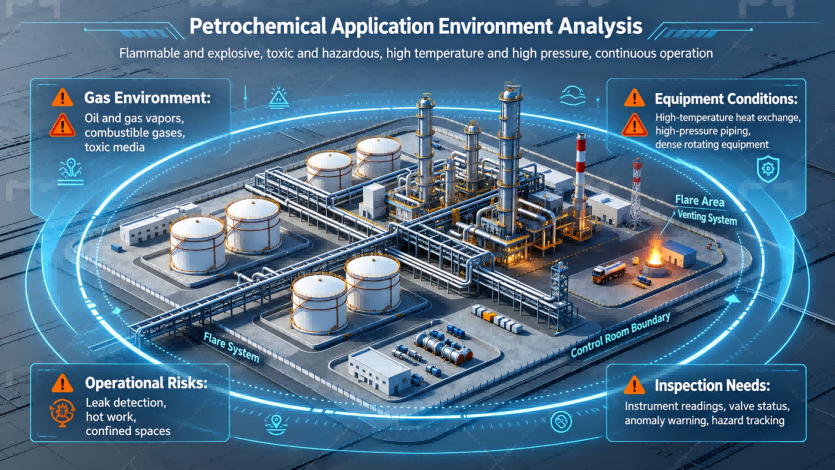 ironments.
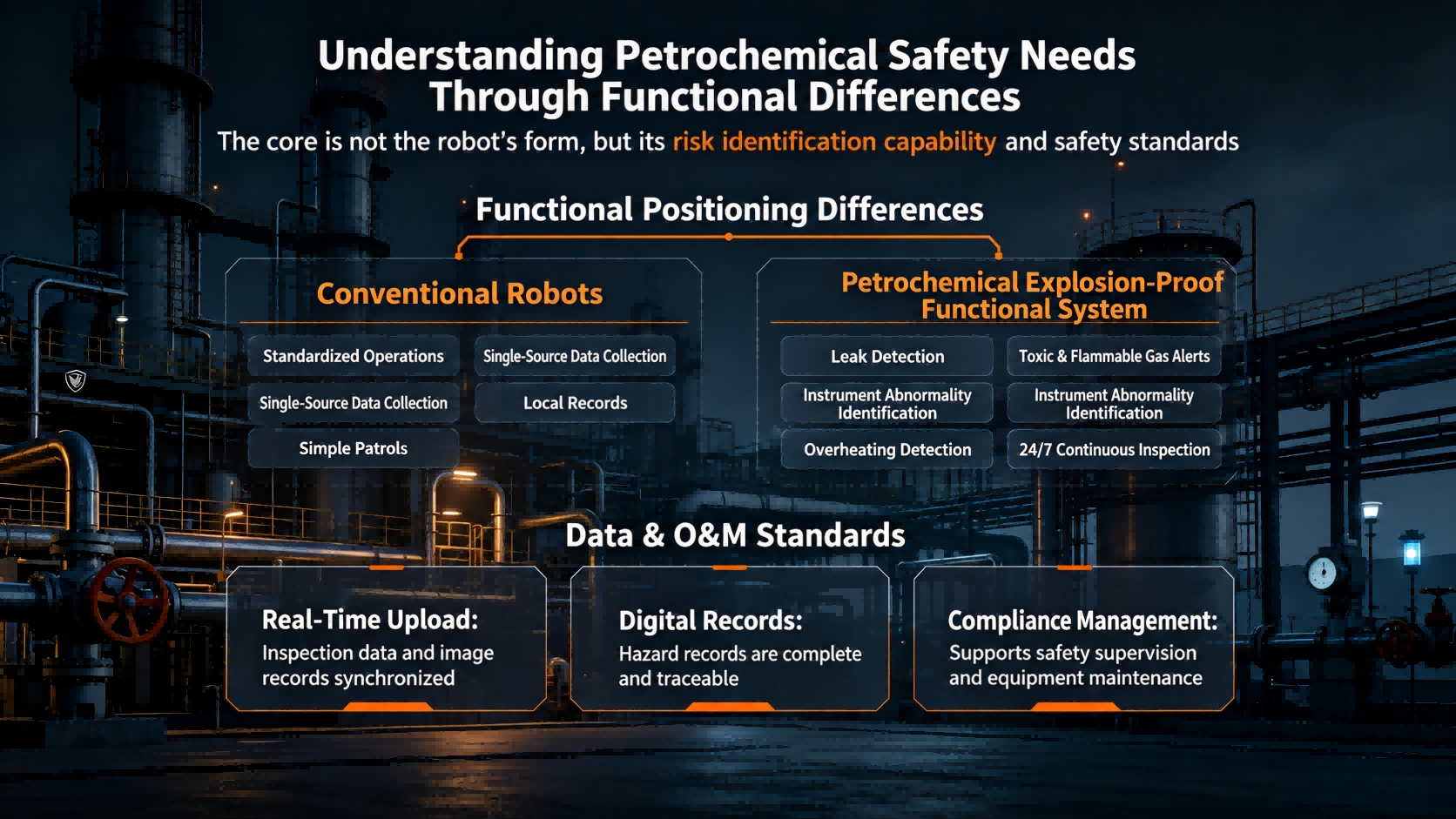
The two types of robots also differ clearly in their core functions and operating roles. Conventional robots generally provide standardized, single-purpose functions, such as precision work on production lines or basic patrols, image capture, and fixed-point monitoring. Their data collection is relatively limited and they lack targeted risk-identification capabilities. Petrochemical explosion-proof special-purpose robots, by contrast, are integrated intelligent systems specifically developed for safe production. They combine infrared temperature measurement, multi-gas detection, high-definition visual recognition, acoustic leak detection, and real-time data transmission. Their primary mission is not simply to "perform tasks", but to "identify risks". They can accurately detect petrochemical safety hazards such as pipeline leakage and seepage, equipment overheating, abnormal instrument readings, and toxic or flammable gas leaks, enabling 24/7 continuous risk inspection and abnormal-condition alerts in line with the core safety requirements of the petrochemical industry.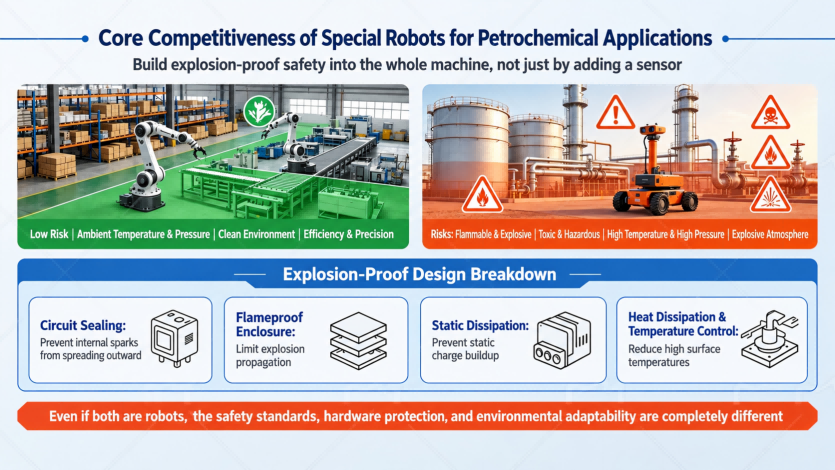
There are also significant differences in data systems and operation-and-maintenance standards. Data from conventional robots is often stored only as simple local records, without standardized logs or meaningful traceability for industrial safety. Petrochemical special-purpose robots, on the other hand, can use 5G industrial networks to upload inspection data, images and video, and hazard records in real time, creating complete and traceable digital logs. This supports the stringent requirements of the chemical industry for safety supervision, hazard review, and equipment maintenance. In addition, their overall system design, testing procedures, and operation-and-maintenance practices are aligned with petrochemical safety standards, giving them substantially higher levels of safety, professionalism, and compliance than ordinary civilian or conventional industrial robots.
In summary, conventional robots are primarily "efficiency tools" designed to improve productivity, whereas petrochemical explosion-proof special-purpose robots serve as a "safety barrier", balancing operational efficiency with the safety requirements of high-risk environments. As intelligent transformation in the petrochemical industry accelerates, these special-purpose robots are becoming indispensable intelligent equipment for safe chemical production, strengthening the digital safety defenses of chemical plants.